The Salinas Grandes are one of the largest and most accessible salt flats in South America, and probably the most photographed landscape in northern Argentina after the Quebrada de Humahuaca. But most of the information available online is designed for those just passing through on a day trip from Purmamarca or Salta. This guide is different: it covers what you need to know to plan your visit—how to get there, when to go, what to find at the salt flat—and also what changes when the visit is not just a quick stop, but rather experiencing the salt flat at night, with an overnight stay on-site.
Where are the Salinas Grandes
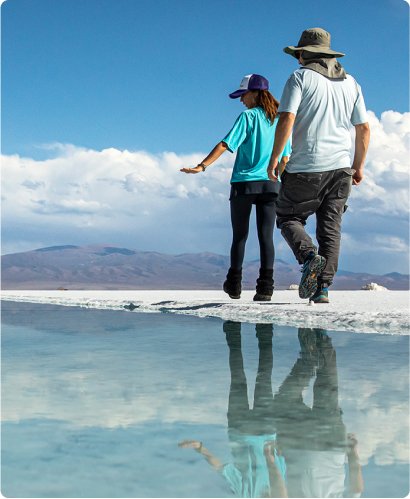
Las Salinas Grandes are located on the border between the provinces of Jujuy and Salta, about 3,450 meters above sea level, in the Argentine Puna. It is a salt flat with an extensive and very flat surface, the result of an ancient lake that dried up, leaving a salt crust several meters thick in some places. The combination of altitude, aridity, and an unobstructed horizon is what generates the landscape that made the place famous: absolute white, clear skies almost all year round, and a sense of scale that is difficult to anticipate in photos.
How to get to Salinas Grandes
The most common access is via National Route 52, which climbs from Purmamarca (Quebrada de Humahuaca) across the Cuesta de Lipán, one of the most spectacular mountain road sections in the north, featuring natural viewpoints overlooking the valley. From Purmamarca, the drive to the salt flat takes approximately an hour and a half by car, traversing a steep ascent that leads from 2,200 meters above sea level in Purmamarca to over 4,100 meters above sea level at the highest point of the slope, before descending again toward the salt flat.
It is also possible to get there from the city of Salta, although the journey is considerably longer, or by combining the visit with a circuit that includes Purmamarca, Tilcara, and the Quebrada de Humahuaca in a multi-day trip—in fact, this is the most common way to experience the region, as the Salinas Grandes usually serve as the conclusion or the beginning of an itinerary through northern Jujuy.
The route is fully paved and passable by private car almost all year round, although it is advisable to drive with caution on the high-altitude section, especially if you are not used to mountain roads.
When to visit the Salinas Grandes
The time of year completely changes what can be seen in the salt flats, and it is the most important question to answer before planning the trip.
Dry season (approximately April to November): The salt flat is shown in its most famous version — the white, hard crust, cracked into geometric polygons that stretch to the horizon. It is the season of best accessibility, with dry and unrestricted routes, and the one that dominates most of the photos circulating of Salinas Grandes.
Rainy season (approximately December to March): In years with sufficient rainfall, a thin layer of water can cover part of the salt flat's surface, creating a mirror effect that reflects the sky with almost perfect clarity — a phenomenon comparable, on a smaller scale, to the one that made the Salar de Uyuni in Bolivia famous. This effect is not guaranteed every year or across the entire surface: it depends directly on the seasonal rains, so it is advisable to check updated conditions before planning a trip specifically to see it.
There is no objectively “best” season — it depends on what landscape you are looking for. Anyone who wants the white salt flat and classic polygon photos goes during the dry season. Anyone looking for the mirror effect aims for the summer months and checks the water conditions close to the travel date.
Height: what to consider
At 3,450 meters above sea level, the Salinas Grandes are at an altitude where some visitors may experience mild symptoms of altitude sickness (headache, fatigue, shortness of breath upon exertion), especially if they arrive from sea level without acclimatization stops. It is not a major risk for the vast majority of people, but it is wise to take simple precautions: hydrate well in the days before, avoid alcohol before ascending, and if the trip includes several days in the altiplano (Purmamarca is already at 2,200 meters above sea level, Tilcara and Humahuaca in similar ranges), allowing one or two days of gradual acclimatization before reaching the 3,450 meters of the salt flats is usually sufficient for most travelers.
What to see and do in the salt flat
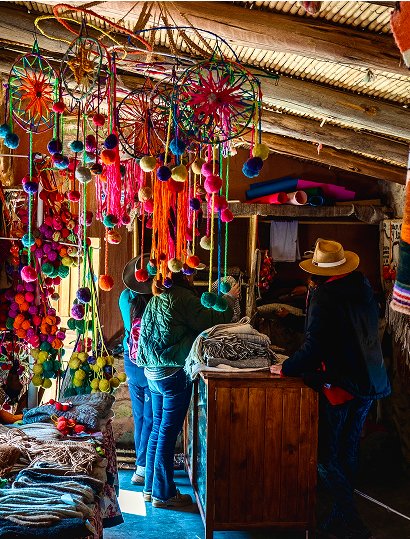
Beyond the walk on the white surface—the central activity of any visit—the usual circuit includes the so-called “water eyes,” small natural perforations where brackish water can be seen beneath the solid crust, and artisanal salt extraction posts where local workers show the traditional process of obtaining block salt, just as it has been done for generations in the area. It is also common to find salt-carved crafts produced by the local villagers themselves.
The light changes radically throughout the day: midday offers the most intense white and the best contrast for photos of the cracked floor; sunrise and sunset bathe the salt flat in pink and golden tones, with long shadows that reveal the texture of the surface in a way that is lost at midday.
Seeing the salt flat by day vs. staying overnight
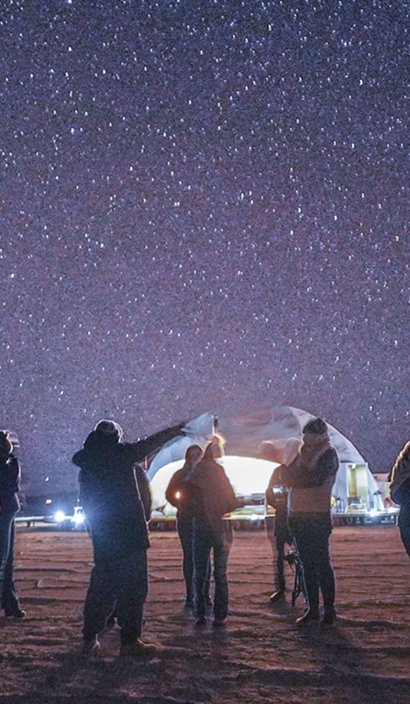
The vast majority of those who visit Salinas Grandes do so on a few-hour excursion, usually as a stop within a broader circuit through the Quebrada de Humahuaca. It is a perfectly valid way to experience the place. But there is an experience that format does not allow: seeing the sunrise and sunset over the salt flat without the pace of a tour bus watching the clock, and witnessing the night sky of the Puna—one of the skies with the least light pollution in the country—from the salt flat itself.
That is the proposal of Pristine Salinas Grandes: a Luxury Camp located right within the salt flat environment, designed for those who want to experience the Salinas beyond the midday photo. If after reading this guide you are interested in knowing the accommodation proposal, the Pristine Salinas Grandes website It has the full details of the experience, the exact location, and availability.